
What is a virtual debit bank card
A virtual debit bank card is a digital version of a payment card that has no physical medium but contains standard credentials: card number, expiration date, and CVV. It is used for the same operations as a regular plastic card. Physical bank cards are not currently implemented in the project.Cards do not have their own money — they draw funds from the account to which they are connected. In Holders, up to 50 cards can be connected to one account, but the bank may set its own restrictions. If limits are not exceeded, a new card can be issued at any time. The card’s currency is the currency of the account to which it is linked.
Please note:
Virtual bank cards in Holders do not have a PIN code, and it should not be requested by merchants during payment. A PIN code request indicates incorrect configuration of the merchant’s payment terminal.
Virtual bank cards in Holders do not have a PIN code, and it should not be requested by merchants during payment. A PIN code request indicates incorrect configuration of the merchant’s payment terminal.
Types of virtual cards in Holders
Holders implements two types of virtual cards:- Non-custodial cards — cards linked to decentralized accounts. Currently, this is the only type of card available for issuance by users.
- Prepaid cards — each such card represents a separate account in a partner bank, with cryptocurrency exchange to fiat funds occurring at the moment of card top-up. Currently, the issuance of such cards is suspended.
Card issuing banks
Holders does not issue bank cards independently. Card issuance is handled by organizations that have the appropriate license obtained from regulators and payment systems.At the current moment, Holders has one main partner bank:
- Wallester - issues Visa cards in EUR for EU residents. The cost of issuing one card for Holders is 1 EUR. For the client, issuing the first card remains free for now, but issuing each subsequent card will cost 7.92 EUR. Card maintenance is free for the client.
All virtual bank cards issued by the partner bank belong to the partner bank, not the client (based on the agreement that the client signs with the issuing bank when the card is issued) and are linked to the Holders account at the issuing bank. The client issuing the card does not have their own account created at the issuing bank.
Available cards
Legal status of cards and distribution of responsibilities
Holders bank cards are issued and serviced by the licensed payment institution Wallester AS in accordance with the rules of the Visa payment system.The client acts as the cardholder, however the legal ownership of the card itself and the payment infrastructure belongs to the issuing bank.
Partner Responsibilities (Wallester/Holders):
- Concluding contracts with clients on behalf of Wallester
- Managing client communications
- Performing KYC/AML verification procedures
- Covering settlement and chargeback expenses, including fraud losses in case of lost or uninitiated disputes
- Maintaining sufficient balance to ensure card operations
- Card issuance and processing
- Compliance with regulatory and Visa payment system requirements
- Right to restrict card operations in case of insufficient Partner funds
Virtual card payment scheme
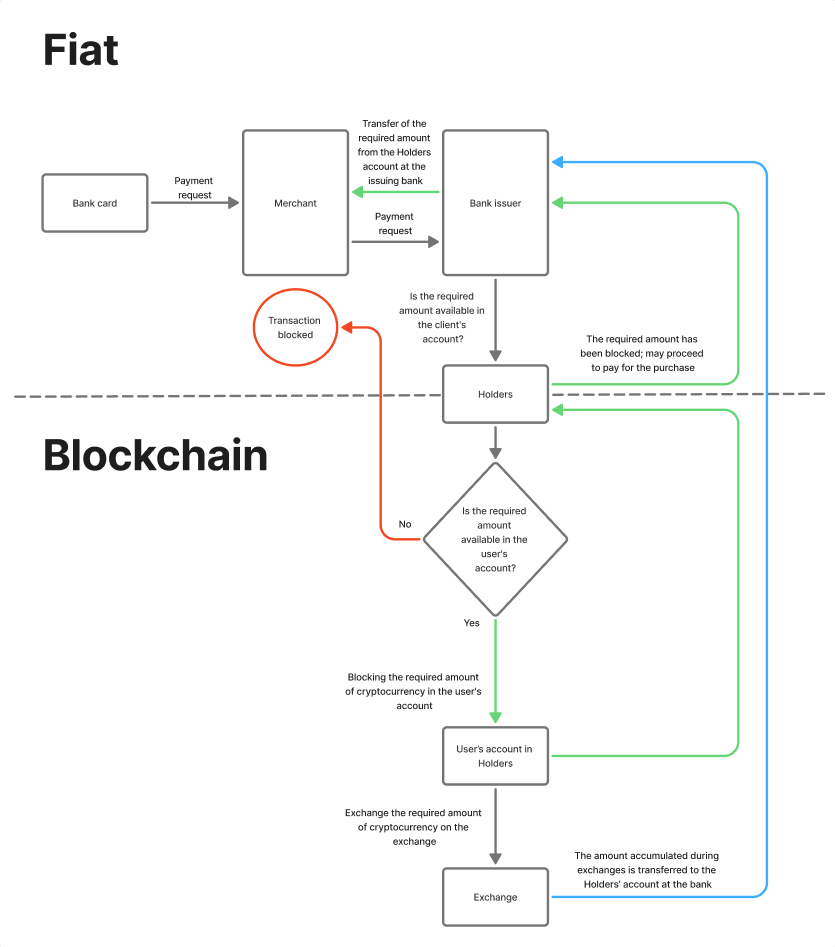
- Client initiates a payment operation
- The merchant’s acquiring bank sends a request to the card issuing bank
- The card issuing bank requests confirmation from Holders for the possibility of conducting the operation
- The Holders system performs a comprehensive verification of the card and account according to the following parameters:
- Absence of card freeze
- Absence of card blocking
- Active card status
- Sufficient funds in the account (in USDC or TON) to pay for the transaction and Holders commission
- Completion of KYC and AML procedures
- Correctness of entered CVC code and 3D-Secure password (for online payments)
- Payment confirmation by the client using the selected method - through the application or 6-digit code (for online payments)
- After successful verification, the Holders backend sends authorization to the issuing bank to conduct the operation
- The issuing bank executes the payment and debits the purchase amount from the Holders account
- The Holders backend creates a debit task, includes it in the rollup, and subsequently debits from the client’s smart contract.
- An order is formed on the exchange to sell the required amount in cryptocurrency.
- The accumulated fiat amount on the exchange is withdrawn to the balance of the Holders account at the issuing bank.
Сard lifecycle
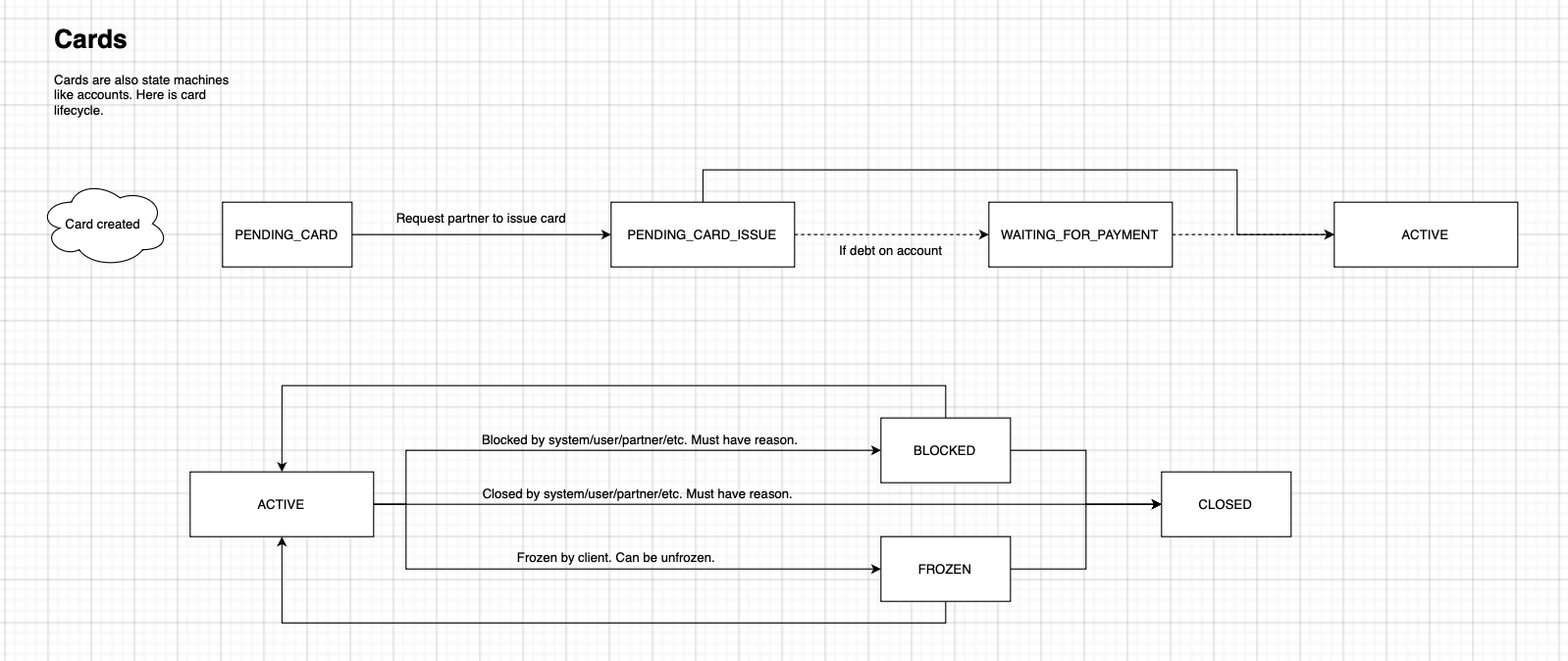
- When card issuance is initiated, the system assigns it the status
PENDING_CARDand sends an issuance request to the partner bank. - Until issuance, the card remains in
PENDING_CARD_ISSUEstatus. After successful issuance, the card receivesACTIVEstatus. In case of paid card functionality activation, a check for account debt is performed before issuance. If debt is detected, the card transitions toWAITING_FOR_PAYMENTstatus. - At the client’s initiative, an active card can be moved to
FROZENstatus. In this status, the card is unavailable for payments but can be unfrozen. - The
BLOCKEDstatus can be assigned to an active card either at the client’s initiative or by the partner bank. This status is irreversible and means complete blocking of the card for payments. - Cards in
ACTIVE,FROZEN, orBLOCKEDstatuses can be closed, after which they receiveCLOSEDstatus and become unavailable in the user interface.