> ## Documentation Index
> Fetch the complete documentation index at: https://whalescorp.mintlify.site/llms.txt
> Use this file to discover all available pages before exploring further.
# Account ownership certificate
> This document explains what an account ownership certificate is in Holders, what information it includes, how to request it, and in which cases it can be used.
# What is an account ownership certificate
The certificate verifies the ownership rights of a specific individual to decentralized accounts in the Holders system. This document serves as an official equivalent to a bank account ownership certificate and can be presented as supporting documentation where required, including to accounting departments of organizations when receiving salary payments in cryptocurrency.
# Travel Rule
[Travel Rule](https://www.fatf-gafi.org/en/publications/Fatf-recommendations/Fatf-recommendations.html) is an anti-money laundering (AML) requirement under which transfers between financial institutions (banks, cryptocurrency exchanges, and others) must include basic information about the sender and recipient (including name, account number/address, in some cases residential address and other data) along with the payment. This requirement enables tracking the origin and movement of funds, as well as preventing money laundering and terrorism financing. A bank account ownership certificate confirms that a specific individual or legal entity is the lawful owner of the specified account.\
The purpose of this document:
* When conducting verification of funds origin and ensuring compliance with Travel Rule requirements, a financial service must verify the following:
* The bank account from which funds originate or to which funds are directed belongs specifically to this client;
* The owner's personal data specified in the certificate corresponds to the information that is transmitted and stored as part of Travel Rule compliance.
Thus, the certificate serves as documentary confirmation for customer identification and anti-money laundering procedures (KYC/AML) and serves as one of the grounds for confirming the correctness of data transmitted in accordance with Travel Rule requirements.
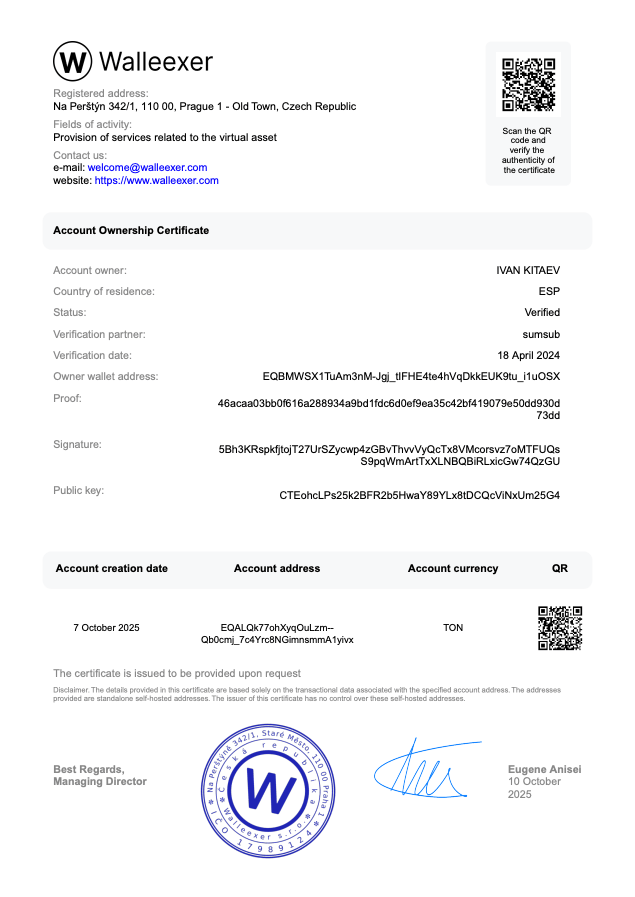
# Certificate example
 # Certificate Data
### Certificate Issuing Company Data
* Logo
* Address
* Identification number
* Business activity
* Contacts
### User Data
* First name, last name
* Country of residence
* Verification status
* Partner who conducted verification
* Date of last verification in the system
### Proof of ownership
* Account owner's wallet address - the wallet address that creates proof of ownership
* Account ownership confirmation - cryptographic element confirming the fact of ownership and control over the account, includes data that can be verified by third parties (random data from the server used for confirmation).
* Signature - signature with the wallet's private key.
* Public key - public key of the verified wallet. Generated from the blockchain or from proof of ownership
### Account Information
* Account creation date
* Account (contract) address
* Account currency
* Account blockchain
### Additional
* VASP seal
* VASP director's signature
# Certificate Validity and Authenticity Verification
You can verify the authenticity and validity of the certificate by scanning the QR code in the upper right corner and following the link of the form: \
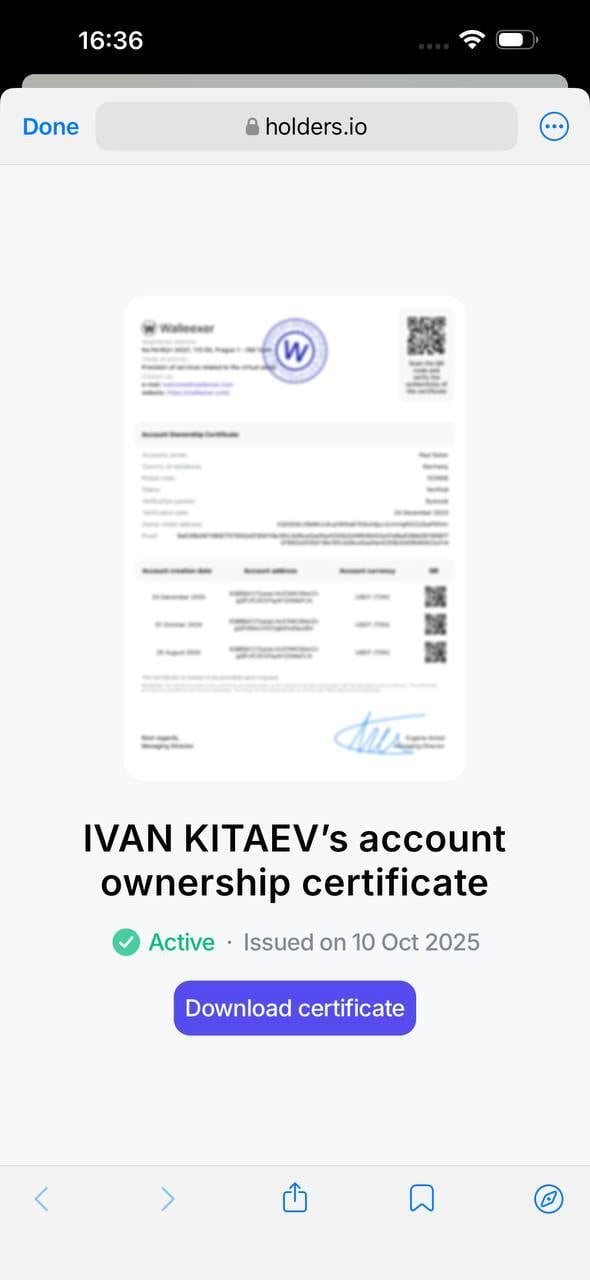
[https://www.holders.io/cert?id=p4r158sdxxxrsapceq6updxc\\\\](https://www.holders.io/cert?id=p4r158sdxxxrsapceq6updxc\\\\) When following the link, a page opens containing the current certificate status, account holder's name and document issuance date. This page also provides the ability to download an electronic version of the certificate.
# Certificate Data
### Certificate Issuing Company Data
* Logo
* Address
* Identification number
* Business activity
* Contacts
### User Data
* First name, last name
* Country of residence
* Verification status
* Partner who conducted verification
* Date of last verification in the system
### Proof of ownership
* Account owner's wallet address - the wallet address that creates proof of ownership
* Account ownership confirmation - cryptographic element confirming the fact of ownership and control over the account, includes data that can be verified by third parties (random data from the server used for confirmation).
* Signature - signature with the wallet's private key.
* Public key - public key of the verified wallet. Generated from the blockchain or from proof of ownership
### Account Information
* Account creation date
* Account (contract) address
* Account currency
* Account blockchain
### Additional
* VASP seal
* VASP director's signature
# Certificate Validity and Authenticity Verification
You can verify the authenticity and validity of the certificate by scanning the QR code in the upper right corner and following the link of the form: \
[https://www.holders.io/cert?id=p4r158sdxxxrsapceq6updxc\\\\](https://www.holders.io/cert?id=p4r158sdxxxrsapceq6updxc\\\\) When following the link, a page opens containing the current certificate status, account holder's name and document issuance date. This page also provides the ability to download an electronic version of the certificate.
 # Proof of ownership in the certificate
To verify wallet ownership by the user, a proof of ownership mechanism is used, implemented using the TON Connect standard ([TON Connect documentation](https://github.com/ton-connect/sdk)).\
When connecting a cryptocurrency wallet to a web application, according to the TON Connect standard, the system requests ownership confirmation. The confirmation is created by signing the following data with the private key:
* Cryptocurrency wallet address
* Domain name of the connecting application
* Timestamp of confirmation creation
* Random data (payload) generated by the server
After forming the ownership proof, the wallet sends the above data set to the server along with a cryptographic signature created with the private key for subsequent verification.
This documentation is built and hosted on [Mintlify](https://mintlify.com), a developer documentation platform.
# Proof of ownership in the certificate
To verify wallet ownership by the user, a proof of ownership mechanism is used, implemented using the TON Connect standard ([TON Connect documentation](https://github.com/ton-connect/sdk)).\
When connecting a cryptocurrency wallet to a web application, according to the TON Connect standard, the system requests ownership confirmation. The confirmation is created by signing the following data with the private key:
* Cryptocurrency wallet address
* Domain name of the connecting application
* Timestamp of confirmation creation
* Random data (payload) generated by the server
After forming the ownership proof, the wallet sends the above data set to the server along with a cryptographic signature created with the private key for subsequent verification.
This documentation is built and hosted on [Mintlify](https://mintlify.com), a developer documentation platform.